24/7 production of synthetic fuels: our game-changing thermal energy storage
Published in 2024, updated in 2026
Synhelion has developed a technology to produce renewable synthetic fuels that cut CO2 emissions versus fossil-based fuels and help the transportation sector achieve its net-zero roadmap.
We use our innovative and proprietary synthetic fuel technology to convert renewable energy into fuels through high-temperature thermochemical processes. To quickly ramp up fuel production, we have developed several thermochemical fuel production processes driven by renewable energy.
Renewable energy is an intermittent energy source, so storing it is a challenge but essential for the production of our synthetic fuels. Without storage, synthetic fuel production would be inefficient and too expensive because we could not run our synthetic fuel plants around the clock. Renewable energy can be stored either with batteries or with a thermal energy storage.
In this article, we explain how Synhelion’s thermal energy storage works, and why this innovation is key to achieve economical large-scale production of renewable fuels.
How to harness the sun’s energy even when it’s not shining
Using the power of the sun means working with the most abundant energy source available on Earth. While our technology is compatible with all renewable energy sources, solar energy is a vital part of what we do, so we’re often asked how we can produce fuel when the sun doesn’t shine.
On average, the sun only shines for about eight hours a day. If we were to run our plants only during those hours, it would mean a daily ramping up and down of chemical processes. Our plants would be out of work for most of the time, and we could not economically and efficiently produce synthetic fuels. It is important and common for chemical plants to be operated 24/7. So, to power our plants around the clock, we store the majority of the renewable heat collected during the day in our proprietary thermal energy storage system so that we can continue to operate the plant at night or during cloudy periods.
One-third of the heat we generate from renewable energy during the day is used to directly power the thermochemical reactor to drive the chemical processes producing renewable syngas. Syngas is the universal key to producing sustainable fuels. The other two-thirds of the heat is stored in the integrated thermal energy storage, enabling continuous 24/7 operation of our plants.
How Synhelion’s thermal energy storage works
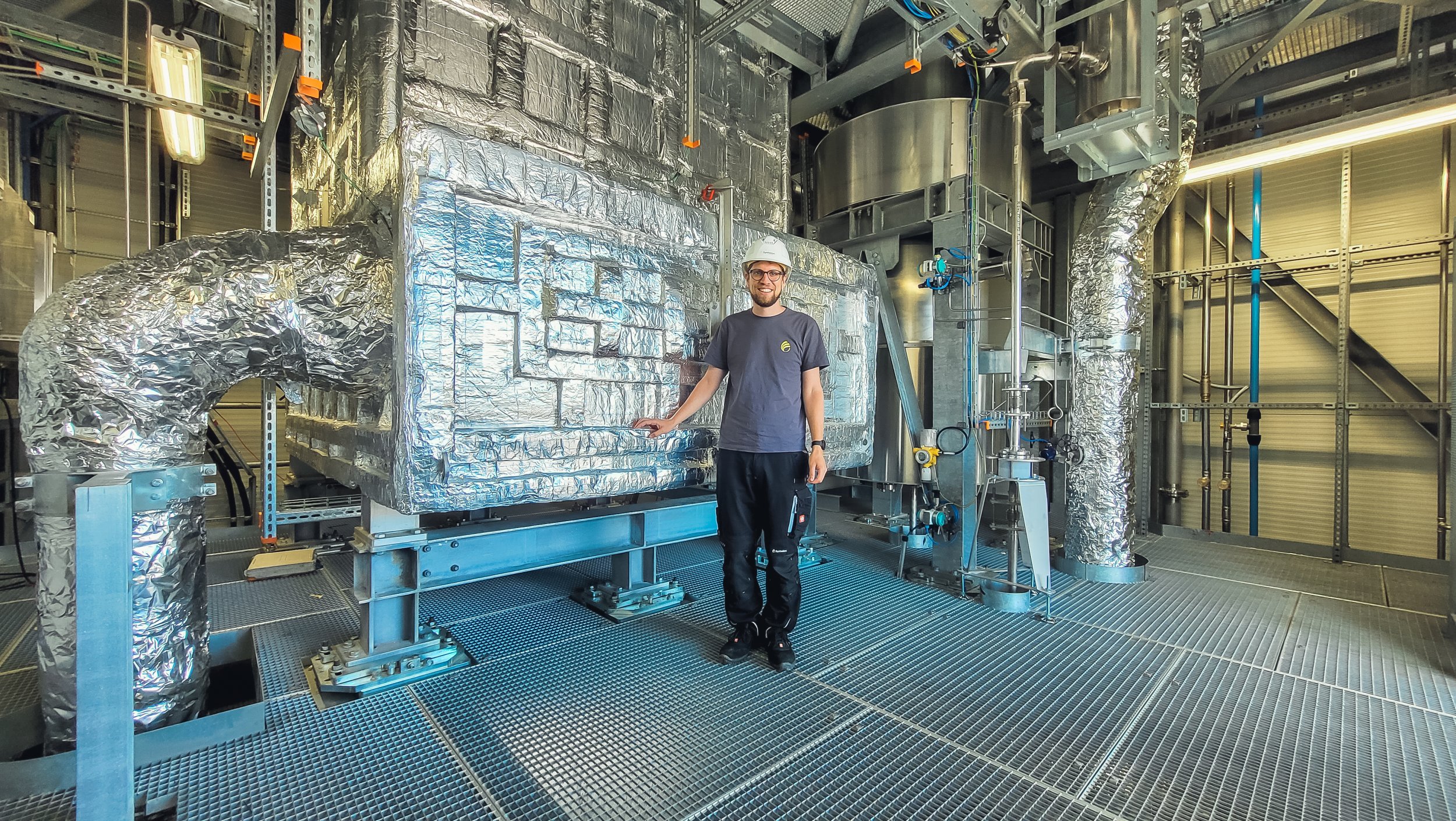
Our thermal energy storage is a straightforward system that we have optimized for our needs. The storage has a rectangular shape and while you can’t see much from the outside, the beauty of our storage is represented on the inside, where you can find finely tuned solid material structures.
Whenever cheap renewable electricity is available, our proprietary electric gas heater generates renewable high-temperature process heat. The high-temperature process heat then heats up steam, our heat transfer medium, to over 1’000 °C. Part of the heated steam flows to our reactor and the other part flows to the thermal energy storage. In the reactor, the heat directly drives our chemical processes for fuel production. In the thermal energy storage, the hot steam flows from top to bottom, transferring the heat to the structures of the solid fire-resistant material, which heats up and stores the heat. At night, or during very cloudy periods, cold steam flows through the storage from bottom to top, absorbing the heat from the solid storage material, enabling us to continuously operate the thermochemical reactor with the stored heat. The solid storage material has a high energy density and stores a lot of heat relative to its mass and volume. This leads to an overall energy storage efficiency of 90 to 98%, depending on the storage size.
Longer-lasting thermal energy storage for higher temperatures
While high-temperature heat recovery through regenerative heat exchangers is widely used in industries such as steel or glass manufacturing, only about half an hour’s worth of storage is the industry standard for these systems. The checker bricks being used in these storages have large holes with limited heat transfer properties, not suitable for effective long-duration thermal energy storage.
Until now, thermal processes have had no means to store high temperatures over a long time. At Synhelion, we convert renewable energy into the hottest process heat on the market. Therefore, we also needed to develop a thermal energy storage system that would not only be able to handle such high temperatures but also store the heat for a much longer period of time.
Synhelion’s innovations include a cost-effective brick design with optimized heat and mass transfer properties and enhanced material properties, such that, ultimately, we can optimize the efficiency and cost of the system.
Our optimizations mean we can store high-temperature heat for longer. Our benchmark is to be able to store and discharge heat throughout the night, i.e. for around 16 hours. This requires several hundred megawatt-hours of storage capacity and determines the size of the thermal storage.
How Synhelion’s thermal energy storage compares to battery storage
Our thermal energy storage technology is at least ten times cheaper than battery storage. By using our solid storage material, we’re also able to avoid the use of rare materials or materials mined in conditions that harm the environment, both of which are common in battery manufacturing.
Crucially, our thermal energy storage is in no way inferior to battery storage in terms of efficiency. At our first industrial-scale plant DAWN, our storage system provides an energy efficiency of up to 90%. At our first commercial plant, the efficiency will rise to 95% due to the increased size and further design optimizations of the storage. And finally, this system requires no regular maintenance other than potentially an occasional standard replacement of maintenance parts. We expect a lifespan of 20 to 30 years.
Synhelion aims to contribute to a net-zero transportation sector by closing the fuel carbon cycle. Our synthetic fuels can directly replace fossil fuels and are fully compatible with existing infrastructure. Developing a thermal energy storage for high temperatures is one puzzle piece to producing renewable synthetic fuels.
Find out more about our technology and subscribe to our newsletter to follow us on our path to clean, sustainable transportation.
