Producing synthetic fuels at fossil fuel prices: a game changer for a resilient and sustainable energy supply
Published in 2026
Liquid fuels remain indispensable for long-haul transportation in aviation, shipping, and heavy-duty road freight, because of their unmatched energy density. Today, fossil fuels power global transportation, accounting for roughly 15% of worldwide greenhouse gas (GHG) emissions.
For decades, renewable drop-in fuels remained too expensive to fundamentally replace fossil fuels. That dynamic is now shifting. Synhelion is changing the equation.
Our recent cost analysis, validated by DNV, a leading independent assessment and certification organization, confirms that at scale, Synhelion can produce renewable synthetic fuels for less than EUR 1’000 per ton (or below EUR 0.8 per liter), placing them within the same range as imported refined fossil fuels.
At the same time, three powerful forces have started to converge, making the shift to renewable synthetic fuels increasingly inevitable:
- Geopolitical dynamics are making fossil fuel supply chains more unreliable and unstable.
- Regulatory pressure to cut GHG emissions from transportation is intensifying worldwide.
- Synthetic fuel projects are reaching a level of maturity where they are becoming bankable.
Reaching production costs below EUR 1’000 per ton at scale is especially relevant for countries that depend on fossil fuel imports. Domestic production of renewable drop-in fuels can strengthen energy independence while creating local value. In an increasingly uncertain geopolitical environment, renewable synthetic fuels offer a pathway to greater energy resilience by reducing reliance on imported fossil fuels.
Energy security and sustainability paired with competitive economics
How can Synhelion achieve the lowest production costs in the renewable fuel industry? The answer lies in several advantages of Synhelion’s unique production pathway, which eliminates key structural cost drivers that constrain many other renewable fuel technologies.
The energy advantage
Most synthetic fuel pathways rely on green hydrogen, which is one of the largest cost drivers for renewable fuel production. All the energy stored in e-fuels is provided via green hydrogen that was produced with renewable electricity. Several conversion steps with associated energy losses further increase electricity demand. Over the last five to ten years, it became clear that green hydrogen remains substantially more expensive (EUR 5 to 10 per kg) than projected, mainly due to higher electricity prices and underestimated CAPEX of the plants.
By contrast, Synhelion’s pathway does not require green hydrogen. Instead, we use cheap and fluctuating renewable electricity when available from solar or wind to generate high-temperature process heat that drives our process. Half of the energy stored in our synthetic fuel comes from renewable electricity and the other half from our feedstock, biogenic waste.
By avoiding hydrogen as an intermediate energy carrier, Synhelion eliminates the electricity-intensive electrolysis step and the associated energy conversion losses. As a result, our process requires approximately three times less electricity than conventional e-fuel pathways, which fundamentally improves operating economics, lowers exposure to power price volatility, and reduces infrastructure requirements. Fewer conversion steps. Lower energy input. Structurally lower cost.
Carbon efficiency and scalable feedstock
Another key challenge of most e-fuels is sourcing carbon in the form of CO2. Each ton of e-fuel requires at least three tons of CO2. The integration of a suitable CO2 source, either biogenic CO2 from a biogas or ethanol plant or CO2 from direct air capture, further increases cost and complexity. For example, the market price of biogenic CO2 ranges from EUR 150 to 250 per ton. For direct air captured CO2, the costs are even higher. The addition of CO2 therefore also contributes significantly to the production costs of e-fuels.
Feedstock availability and scalability, as well as cost volatility, also constrain renewable fuel pathways that rely on waste oils or animal fats (HEFA/HVO). These lipid-based feedstocks are not scalable and will become increasingly limited. HEFA pathways will hit their feedstock limit between 2030 to 2035, which means that further scaling of this pathway requires cultivation of vegetable oil crops. To help satisfy the exponential growth in demand for sustainable aviation fuel (SAF) over the next decades, the majority of future SAF supply therefore needs to come from highly scalable pathways, such as Synhelion’s.
Synhelion uses raw biogas from RED-certified sustainable biogenic waste, one of the lowest-cost renewable carbon sources. Raw biogas consists of methane (CH4) and CO2, which means Synhelion doesn’t require a separate CO2 source like e-fuels. Biogenic waste is produced wherever organic material decomposes and is therefore a continuously generated, broadly available resource. According to the International Energy Agency, there is much more biogas available than we need to produce jet fuel for the entire aviation sector.
Beyond feedstock choice, conversion efficiency is critical. Synhelion’s thermochemical process achieves more than 90% energy and carbon efficiency and delivers two to three times higher carbon utilization compared to other pathways. Higher carbon utilization means more fuel output per unit of carbon input. This reduces the feedstock required per ton of fuel and lowers exposure to supply bottlenecks and price volatility that other pathways face.
Renewable fuel pathways at a glance
HVO/HEFA (Hydrotreated Vegetable Oil/Hydroprocessed Esters and Fatty Acids) are produced by refining waste oils and fats. They represent the largest share of renewable fuels today but are limited in scale due to constrained feedstock availability.
E-fuels are produced by combining CO2 with green hydrogen generated from water using renewable electricity. This pathway is energy-intensive, involves multiple conversion steps, and leads to high production costs.
Synhelion’s technology can be situated between these two ends of the renewable fuel spectrum. We use high-temperature process heat generated from renewable electricity to convert certified biomethane, CO2, and water into syngas via a thermochemical process. The syngas is then refined into sustainable drop-in fuels using standard industrial processes.
Continuous plant operation
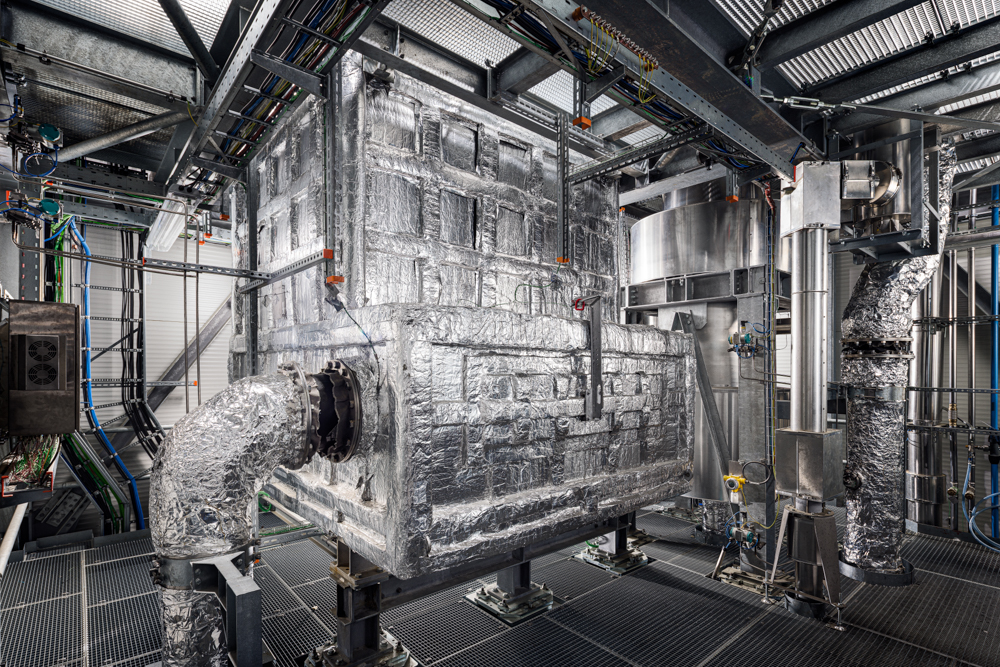
The major challenge in using cheap renewable energy for industrial processes is its intermittent nature. This is where one of Synhelion’s key inventions comes in, the low-cost thermal energy storage (TES), which puts our technology ahead of the curve and enables continuous 24/7 operation.
Part of the renewable heat produced by our electric gas heater is stored in the TES, ensuring that our process operates around the clock at high capacity – even when low-cost renewable energy is unavailable (for more information about our cost-effective TES, see here). Thanks to the TES, which is around ten times cheaper than battery storage, our plants can run at high capacity without daily ramp-up and ramp-down cycles, which significantly improves asset utilization and reduces operating costs.
Scaling up: optimizing plants, locations, and technology
Economies of scale will play a key role in reducing the production costs of renewable fuels. First, larger plants will increase production output, significantly improve capital efficiency, and reduce capital cost per ton of fuel produced.
Second, standardized manufacturing of key plant components shortens construction times and lowers equipment costs. This will particularly be relevant for Synhelion’s anticipated transition to a CAPEX-light technology licensing model (from 2030).
Third, optimized plant locations reduce operating expenses. Future large-scale facilities will be built where renewable energy is abundant and low-cost, and where feedstock supply and infrastructure are easily accessible. Ports and industrial hubs are particularly attractive locations.
Finally, continuous technology improvements further increase system performance. Advancements in reactor design, improved feedstock handling, and further process integration will increase fuel yields and further reduce production costs.
Together, these factors create a clear pathway from demonstration to cost-competitive large-scale commercial production.
Synhelion changes the economics of renewable fuels
Synhelion has already proven that planes, ships, buses, cars, and motorcycles run as seamlessly on our renewable drop-in fuels as they do on conventional jet fuel, diesel, and gasoline. Technical feasibility is no longer the central question. The decisive factor is cost. Reducing the production costs of renewable fuels is critical to ensure that these solutions become the standard choice and reduce the world’s dependence on fossil fuels, while strengthening long-term energy resilience.
Synhelion has built a production system that can produce renewable synthetic fuels in the price range of fossil fuels. Without the need for green hydrogen, it combines lower electricity demand, low-cost feedstock, highly efficient carbon utilization, continuous 24/7 operation, and a clear commercial scale-up pathway.
Together, these specifications reduce both capital intensity and operating cost, enabling the production of renewable synthetic jet fuel, diesel, and gasoline for less than EUR 1’000 per ton (less than EUR 0.8 per liter) at scale. A critical number that has been third-party validated and confirms the cost potential of Synhelion’s technology.
As production scales, renewable synthetic fuels will no longer be a premium product, but a competitive commodity powering global transportation.
Find out more about our renewable synthetic fuels and subscribe to our newsletter to follow us on our path to clean, sustainable transportation.
