Synhelion’s affordable synthetic fuel technology platform offers energy security and resilience
Published in 2026
Global energy markets are facing unprecedented pressure in the first half of 2026. According to the International Energy Agency (IEA), the conflict in the Middle East and restrictions in the Strait of Hormuz have led to “the largest disruption in history” of oil supply. As governments and industries grapple with these circumstances, the case for locally produced renewable fuels has become a question of national resilience, not just climate policy.
A system under strain
Fossil fuels are so deeply embedded in today’s life that we tend to forget how fragile their supply chains really are until a major shock reminds us. Today’s geopolitical environment exposes the vulnerability of global energy supply. Wars, disrupted trade routes, weaponized resources, and attacks on critical infrastructure – pipelines, refineries, shipping lanes, and power grids – have made one thing clear: energy independence is an immediate strategic necessity.
Disruptions in the fossil fuel supply chain affect many countries around the world, particularly those that depend on fossil fuel imports, and the cost of that exposure is rising. Oil shocks don’t just raise fuel prices. They ripple through every sector that touches petrochemicals – manufacturing, food production, pharmaceuticals – and feed directly into inflation, corporate earnings, and household spending.
Synhelion’s technology offers a viable solution for energy security. One that is ready to deploy today, and one that becomes more affordable as it scales. Unlike fossil fuels, whose costs are tied to finite reserves and volatile markets, the production costs of our renewable fuels fall with scale. At scale, we’ll reach long-term production costs below EUR 1’000 per ton, which is in the range of refined fossil fuels.
The geopolitical pressure on fossil supply chains is a stark reminder that renewable synthetic fuels are more than a climate solution. Coupled with tightening emissions regulations around the world and the growing bankability of synthetic fuel projects, the shift to renewable fuels has become inevitable.
An autarkic path to energy security
Synhelion’s renewable fuel technology offers a real alternative to fossil fuels. Our renewable synthetic jet fuel, diesel, and gasoline are fully compatible with global fuel infrastructure and existing engines. The technology is designed to operate in different environments and with any renewable energy input – photovoltaic, wind, or concentrated solar – which makes it deployable almost anywhere in the world.
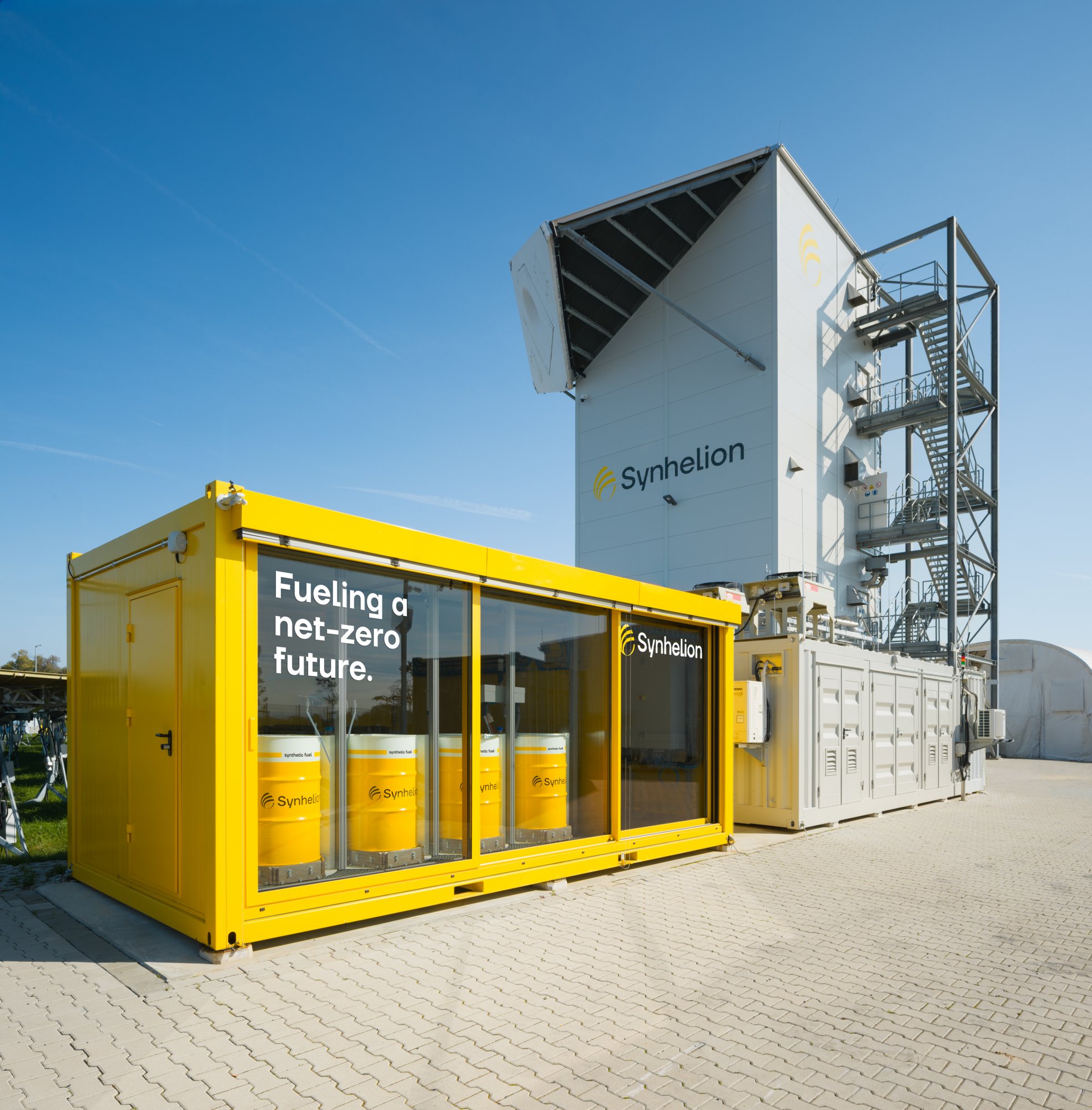
This is not a concept on paper. DAWN, our industrial-scale plant, has been operational since 2024, proving the pathway from production to delivery to real-world use. Synhelion’s technology enables an autarkic, locally generated energy supply: fuels produced where they are needed, independent of the fragility of geopolitics and global supply chains. No new pipelines. No new vehicle fleets. No new fueling networks. Just a resilient, decentralized supply – ready to deploy now.
Setting a new standard for renewable synthetic fuels
Synhelion’s technology platform offers a combination that no other renewable fuel pathway delivers at once:
- Affordable: At scale, Synhelion can produce synthetic fuels below EUR 1’000 per ton – in the range of refined fossil fuels. The figure has been validated by DNV, the independent assurance and risk management firm.
- Predictable: Synhelion’s technology offers predictable production costs, thereby protecting economies, airlines, and industries from the price shocks that regularly destabilize national budgets and corporate planning.
- Independent: Produced from abundant local energy and feedstock, our synthetic fuels can shield economies from import shocks, sanctions, and chokepoint disruptions.
- Compatible: Our liquid drop-in fuels work with today’s vehicles, ships, and aircraft, with no infrastructure overhaul required.
- Sustainable: Synhelion’s fuels are CO2-neutral by design. They only emit as much CO2 as was used during production, closing the carbon cycle.
This combination of economic viability, predictable production costs, independence, compatibility, and climate performance is what makes the Synhelion technology platform a true game changer for the global energy system.
Why this matters beyond fuel markets
Energy resilience is national resilience. Liquid fuels power the transportation sectors that cannot be easily electrified – aviation, shipping, and long-haul logistics. When those sectors are exposed to fossil supply risks, so is everything they enable: mobility, trade, food supply, and the independence of nations and industries. Producing renewable synthetic fuel at production costs in the range of refined fossil fuels changes that equation. It turns geopolitical dependency into a local capability.
And resilience, once built locally, generates value locally. According to the IEA, scaling sustainable fuels could create nearly two million jobs worldwide by 2035 – turning energy security into a source of domestic economic opportunity, not just strategic protection.
The Synhelion advantage
To understand how Synhelion achieves these economics – including why our pathway requires no green hydrogen and delivers two to three times higher carbon utilization than competing approaches – read our detailed blog article “Producing synthetic fuels at fossil fuel prices: a game changer for a resilient and sustainable energy supply”.
Find out more about our renewable synthetic fuels and subscribe to our newsletter to follow us on our path to clean, sustainable transportation.
