Two years of plant DAWN: proving synthetic fuel production at industrial scale
Published in 2026
In 2024, we switched on plant DAWN for the first time. Since starting production in late summer that year, we have gained invaluable operational experience, de-risked our technology, and built an expert team that masters the challenges of a first-of-a-kind plant like this.
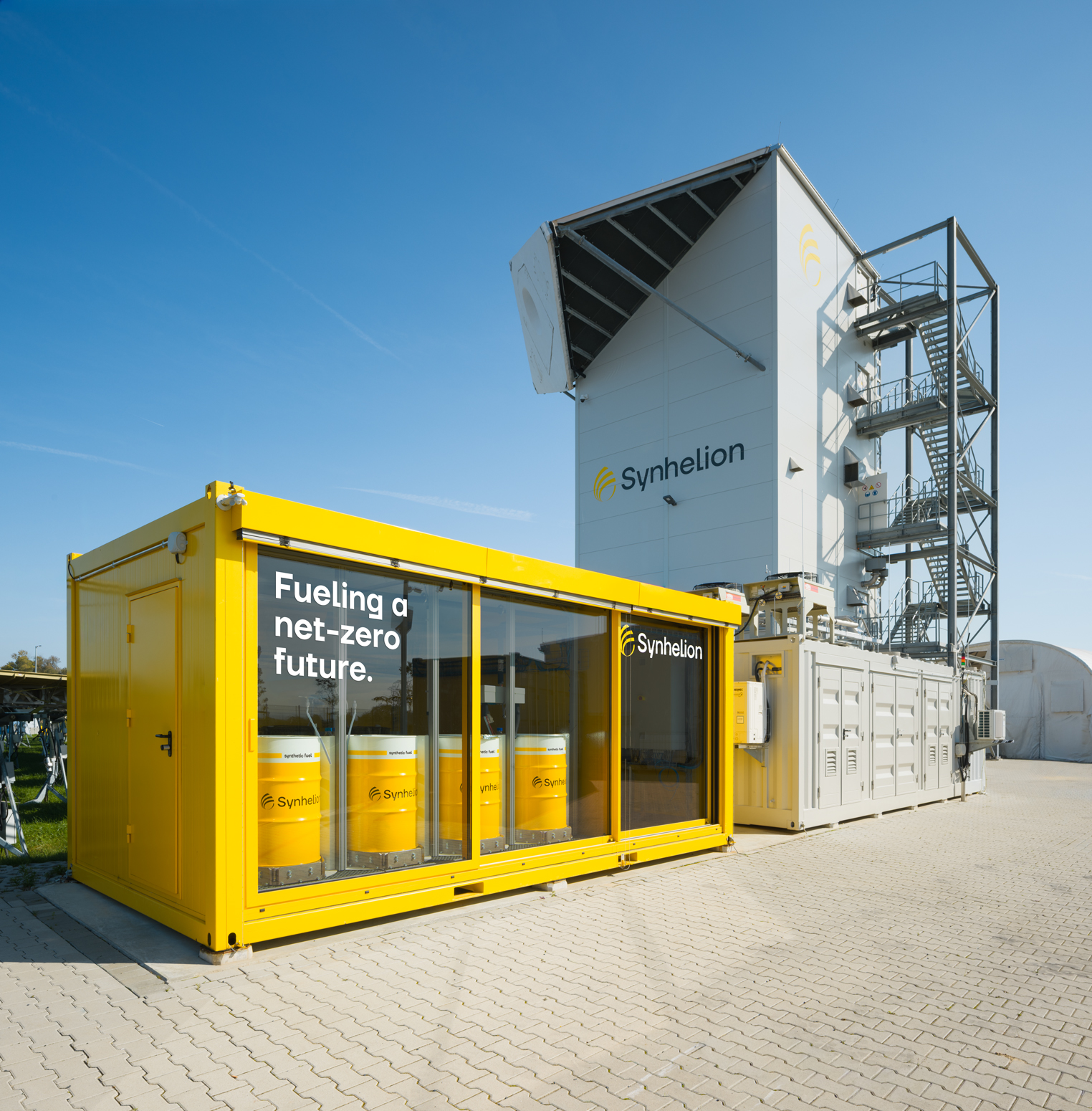
As the name indicates, DAWN marks the beginning of a new era for transportation. It lays the foundation for the next generation of renewable fuels: scalable, affordable, and synthetic. It wasn’t built to produce as much fuel as possible. It was built to prove that Synhelion’s technology works at industrial scale. Based on the past two years, we can now say with conviction – and based on real data – that it does.
Many renewable fuel projects are being developed as the importance of independent, sustainable energy supply rises on the global agenda. However, only few approaches can scale and reduce costs to the level required. And even fewer of those technologies have moved beyond the lab or pilot stage into real-world industrial operation. DAWN is one of them.
Looking back at what we have achieved, plant DAWN offers invaluable insights into the realities of operating a first-of-a-kind synthetic fuel plant and lays the groundwork for Synhelion’s commercial full-size plants.
What plant DAWN has proven
Synhelion built DAWN on time, on budget, and fully functional as designed. The goal of realizing DAWN was to prove that our technology works at industrial scale and to gain the experience needed for the next scale-up steps – from project execution, team organization and operational experience to proving how our fuels can be integrated into existing value chains. The past two years confirm that we have achieved our objectives.
Synhelion’s technology has been validated and is ready to scale
DAWN integrates Synhelion’s core innovations on an industrial scale. It demonstrates the whole process chain from feedstock to liquid synthetic fuel in an operational environment. DNV, a leading independent assessment and certification organization, has validated that we have reached Technology Readiness Level (TRL) 7 at plant DAWN, which means major technology risks have been eliminated.
Why is TRL 7 an important milestone?
TRLs are a measurement system originally developed by NASA to assess the maturity level of a technology, reaching from 1 for fundamental research to 9 for fully mature implementation. By reaching TRL 7 at plant DAWN, Synhelion has crossed the critical threshold of stress-testing its technology under the real-world conditions it was designed for. In an industry where most technologies stall at the lab or pilot stage, this is a defining achievement.
The plant performs as expected
DAWN’s core is Synhelion’s technology platform to produce synthetic gas, or syngas, which is then liquefied into synthetic crude oil using commercially available gas-to-liquid processes. It consists of three elements: the electric gas heater, the thermal energy storage, and the reformer. The syngas production has reached the plant’s full nameplate capacity, meaning that DAWN is operating as designed.
Highlight numbers of our three core components include:
- The electric gas heater reaches outlet temperatures of more than 1’150°C. As our entire system is designed to work with high-temperature heat, this achievement is critical.
- The reformer achieves an energy efficiency of close to 80%. This is a remarkable result for a unit of this size, since small reformers suffer from proportionally higher heat losses. In our next plants, the reformer will achieve an efficiency of more than 95%.
- The thermal energy storage (TES) achieves a roundtrip efficiency of over 85%. Again, the result is impressive for the small size of the TES, since heat losses scale with the surface-to-volume ratio of energy storage systems. The efficiency of our TES will rise to over 95% for larger units in future plants.
These results show that Synhelion’s core technology performs as required today and will become even more efficient at larger scale.
Engineering terms explained
- Nameplate capacity: This is a standard in the design of almost every physical technology. It refers to the maximum potential output that a technology can achieve under nominal operating conditions.
- Reformer efficiency: The share of supplied thermal energy converted into chemical energy in the syngas.
- Roundtrip efficiency: The share of supplied thermal energy that can be recovered and used to drive the reformer after storage.
Synhelion’s production costs are moving into the range of fossil fuels
The data points we measure and collect at plant DAWN provide Synhelion with a solid basis to project how production costs will develop as we scale. They are the basis for the techno-economic assessment that we recently refined to reliably project our long-term production costs. As the leading independent assessment and certification organization DNV confirmed, Synhelion can produce renewable synthetic fuels for less than EUR 1’000 per ton at scale. This figure represents the most competitive production cost of all sustainable fuel pathways and pushes into the realm of refined fossil fuels.
In the synthetic fuel industry, cost projections are often based on lab experiments or small pilot projects and tend to underestimate CAPEX and OPEX, due to undervalued industrial complexity and non-conservative cost assumptions for feedstocks and power. Synhelion, on the other hand, now has a track record from DAWN’s industrial-scale operation to substantiate its cost estimates. DNV independently validated and benchmarked them against alternative renewable fuel production pathways under the same conditions, based on publicly available market information as well as their vast industrial experience and insights.
Our fuels meet high quality standards
The syngas that plant DAWN produces is liquefied through a Fischer-Tropsch synthesis unit. The resulting syncrude is then upgraded into synthetic jet fuel, diesel, and gasoline. Our fuel products are fully compatible with existing infrastructure and engines, as we could show with several real-world applications thanks to DAWN.
We delivered syncrude to a refinery in Northern Germany, where it was co-processed with fossil crude oil into certified Jet-A-1 aviation fuel for Swiss International Air Lines. Our synthetic diesel and gasoline are also fully compliant with national and international standards and have been delivered to customers, including AMAG Group, Zurich Airport, Lake Lucerne Navigation Company, and Eberhard Unternehmungen.
Insights from the field
Since plant DAWN first came online in 2024, our team has professionalized commissioning, production, operations, and maintenance processes across the board. As a result, DAWN operations are consistent, our core components perform at the availability we require, and the syngas and syncrude we produce meet the quality standards for commercial fuel production.
Since starting fuel production, we have continued to operate the plant in multiple campaigns throughout the year, each dedicated to the testing and technical validation of specific aspects of our technology. A new production facility like DAWN can’t run at 100% capacity right away but needs to be ramped up steadily. For example, we have increased the operating temperatures of the electric gas heater over multiple campaigns up to nominal conditions to detect potential issues early on. In the same vein, we adjusted the composition of our syngas to fine-tune it for the Fischer-Tropsch synthesis and have achieved continuous 24/7 production of syngas and syncrude over several weeks.
Our thermal energy storage (TES) is key to making our operations more flexible. It stores heat when renewable electricity is abundant and inexpensive, then releases it later to keep the reformer running. The TES has performed according to its design, enabling continuous operation while allowing us to shift electricity consumption to periods of abundant renewable power. This supports a grid-friendly operation and reduces power costs.
Furthermore, we increased the automation of our process control system by improving, implementing, and testing new control loops and AI. This greatly reduced the need for human intervention and made plant operations more efficient. Moreover, we developed preventive maintenance plans and improved our spare parts management in collaboration with suppliers to increase reliability and plant uptime. However, working with a first-of-a-kind plant also inevitably means that there are challenges.
For example, the operating temperature of the high-temperature fan was limited at the beginning due to an overheating issue of the bearings. This required a thorough thermal analysis of the situation and a redesign of the shaft and bearing section. Thanks to improved cooling and instrumentation, we managed to increase the operating temperature to nominal conditions quickly with the new design, demonstrating the importance of extended operation under real plant conditions.
DAWN successfully produces syngas, but at its heart, the plant is a facility to identify opportunities to further improve the design, performance, reliability, and maintainability of our technology. It allows us to detect potential design or material issues that we can correct before further scaling. All technical issues at DAWN that are typical for a first-of-a-kind plant have now been solved. Since the next plants will have a similar operational complexity as DAWN, every improvement will be directly implemented.
The road ahead
No lab condition or simulation would have shown us what it truly takes to run an industrial facility, strengthen organizational structures, and build value chains like DAWN has. Synhelion now has a highly trained engineering, operation and maintenance teams that are prepared to design, commission and run larger-scale production facilities.
For our next plant, we are scaling our core technology – the electric gas heater, the thermochemical reformer and the thermal energy storage – by a factor of ten. It will serve as the blueprint for our first full-scale plant. Based on our achievement of TRL 7 at DAWN, the planned scale-up factors, and design modifications, DNV confirmed that Synhelion’s technology will reach TRL 8 after few months of successful operation of our next plant and then TRL 9 with the first full-scale plant. Achieving these target TRLs is therefore a matter of execution, not uncertainty. Reaching full maturity opens the door to licensing our technology to energy companies and deploying it globally at an accelerated pace.
Two years ago, DAWN was a promise. Today, it is proof. The plant shows that the remaining challenge is no longer technological. With a highly trained operation and maintenance team, real plant data, and independently validated technology, Synhelion is now well prepared for the next phase: making renewable synthetic fuels affordable and available at large-scale.
Find out more about our renewable synthetic fuels and subscribe to our newsletter to follow us on our path to clean, sustainable transportation.
